 SailNoted
explainer
Why a Logbook Matters: Preserving Your Vessel’s History
For centuries, mariners have kept logbooks because memory is imperfect and the details of a voyage matter. Position, weather, course, sail changes, machinery use, unusual events, and decisions made along the way all become more useful when they are recorded rather than remembered. On a modern cruising boat, that record can do more than document where the vessel has been.
Over time, it becomes part of the vessel’s history: a record that helps explain how the boat has been used, how its systems have behaved, and what happened before something changed.
vessel-data · logbook
Published August 15, 2026
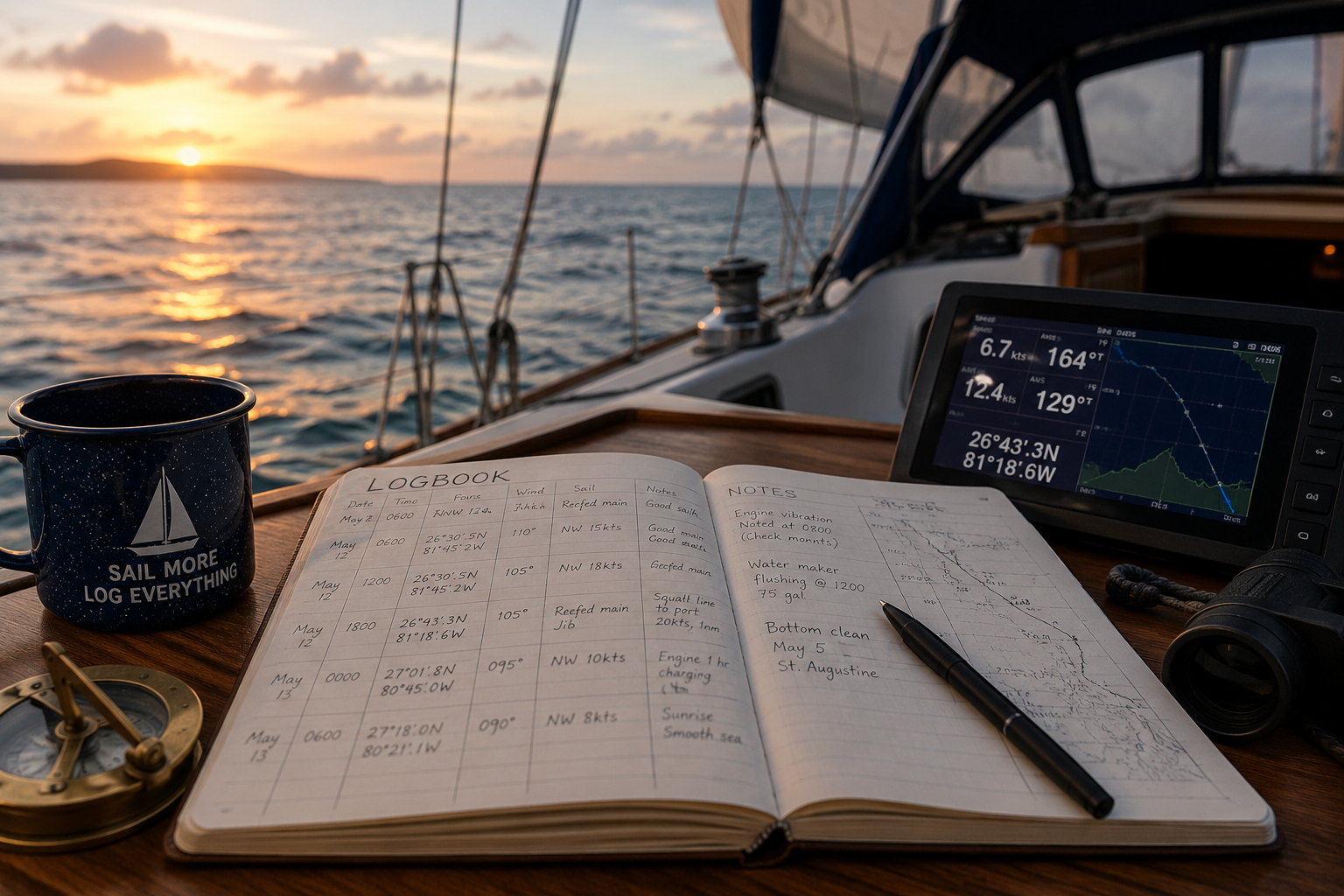
The enduring logbook
More Than a Record of the Voyage
Long before electronic instruments, satellite navigation, or digital sensors, mariners kept logbooks to preserve the details that mattered: position, course, weather, sea conditions, sail changes, machinery use, and significant events. The log provided a record that did not depend on memory and could be reviewed long after a watch, passage, or voyage was over.
That basic purpose has not changed. What has changed is the amount of information available aboard a modern vessel and the number of decisions influenced by it. Navigation systems, engines, electrical systems, batteries, weather instruments, and networked sensors continuously tell us something about how the boat is operating. At the same time, the crew contributes observations that instruments cannot capture: an unusual vibration, a change in handling, a developing weather pattern, or the reason a particular decision was made.
A useful logbook brings those pieces together. Individual entries may seem routine when they are made, but over time they create a history of the vessel—where it has been, how it has been operated, what its systems have done, and what the crew observed along the way.
That history is more than a diary of a voyage. It becomes a practical record of experience that can remain useful long after the original entry was made.
What gets remembered
What a Good Logbook Preserves
A useful logbook records more than position and weather. It captures enough context to reconstruct what was happening aboard the vessel and why it mattered.
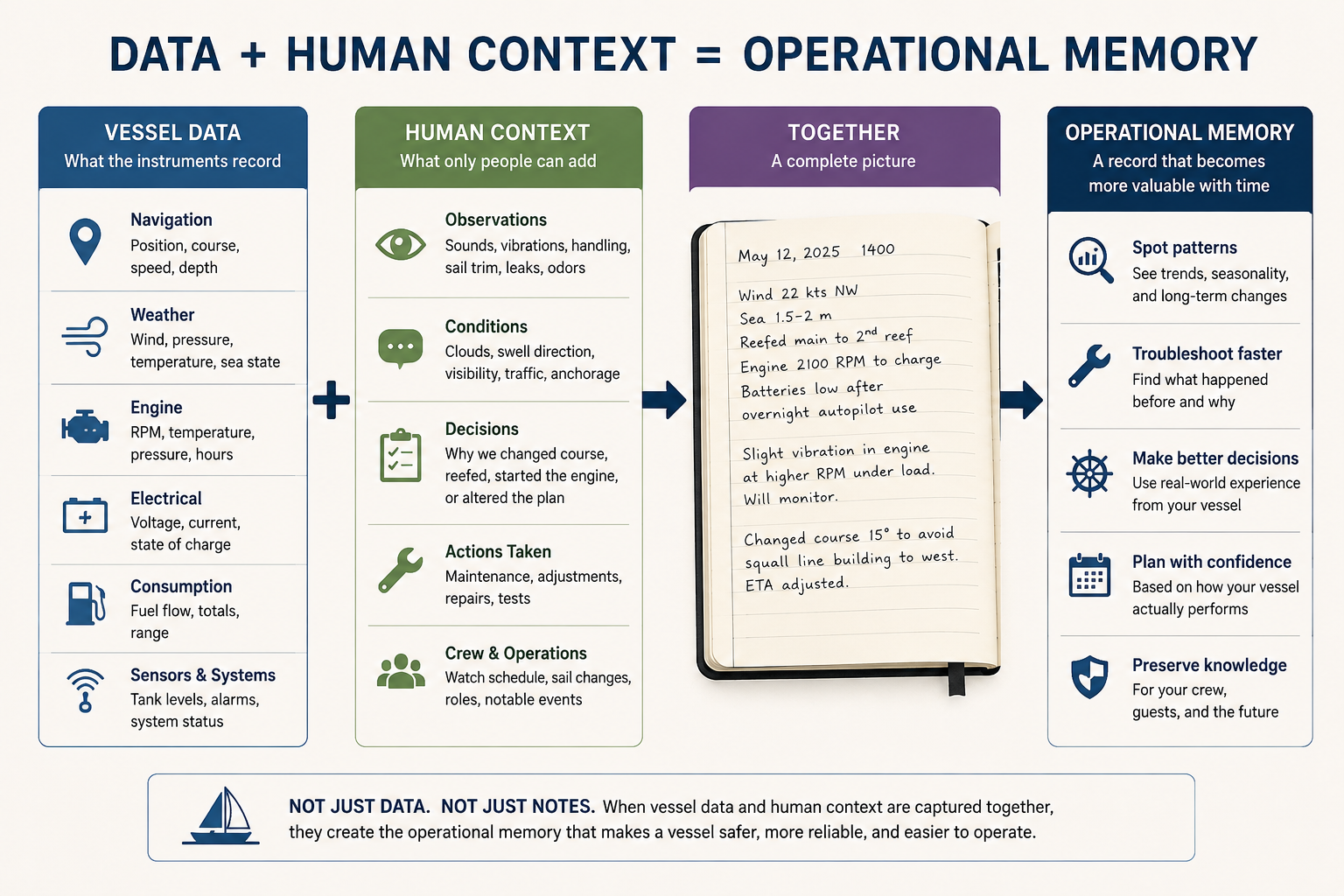
Some information is objective: position, course, speed, wind, barometric pressure, engine hours, battery state, fuel use, or sail configuration. Other information depends on human observation: an unfamiliar vibration, a change in steering feel, reduced charging performance, an unusual sound from the engine, or weather developing differently than expected.
Just as important are the decisions made in response. A course change, reef, engine start, altered watch schedule, or maintenance action may be obvious at the time but much less so weeks or months later. Recording the reason preserves context that raw measurements alone cannot provide.
The value is not in recording everything. It is in preserving the information that helps explain the vessel’s condition, operation, and decisions at a particular point in time. Taken together, those entries create a record that can later answer not only what happened, but often why.
Value over time
The Record Becomes More Useful with Age
A single log entry captures a moment. A collection of entries reveals patterns.
Over weeks, months, and years, the logbook provides a baseline for understanding how the vessel normally behaves. Fuel consumption can be compared across passages. Battery performance can be viewed in the context of loads and charging conditions. Changes in engine temperature, pressure, vibration, or other operating characteristics can be recognized as departures from an established history rather than isolated observations.
That history can be particularly valuable when troubleshooting. A problem that appears new may have occurred before under similar conditions. A gradual change that was difficult to notice day to day may become obvious when earlier observations are available for comparison. Maintenance records gain context when they can be connected with the symptoms and operating conditions that led to the work.
The same is true of seamanship decisions. Previous passages provide a record of how the vessel and crew responded to particular combinations of wind, sea state, sail configuration, loading, and weather. The log does not make future decisions, but it preserves experience that would otherwise depend on recollection.
The longer that record is maintained, the less it resembles a collection of individual entries and the more it becomes a history of how the vessel actually operates.
Data is not memory
Modern Boats Produce Data, Not Context
A modern vessel may generate thousands of measurements every minute. Navigation instruments, NMEA 2000 devices, engines, batteries, chargers, weather sensors, and other systems continuously report what is happening aboard.
That data can be valuable, but by itself it is not a logbook. A stream of positions, voltages, temperatures, pressures, and engine parameters records measurements without necessarily preserving their significance. It may show that something changed without explaining what the crew noticed, what action was taken, or why a decision was made.
The opposite is also true. A handwritten note such as “engine sounded different after lunch” preserves an observation but provides little supporting context unless it can be related to engine load, temperature, RPM, sea state, or other conditions at the time.
The most useful operational record combines both. Automated data provides precision and continuity. Human entries add judgment, observations, decisions, and meaning. Together they create a much richer account of what was happening aboard than either can provide alone.
That distinction matters because collecting data is easy. Preserving useful context is what turns that data into a meaningful record of the vessel’s history.
Looking back to move forward
A Logbook Should Become More Valuable Over Time
The immediate purpose of a logbook is to record what is happening now. Its greater value is in making that information useful later.
A well-maintained record allows a vessel’s history to accumulate instead of disappearing into instrument displays, scattered maintenance notes, or the crew’s memory. Observations can be connected with operating conditions. Maintenance can be viewed alongside the symptoms that preceded it. Decisions made during one passage can provide context during the next.
Over time, a good logbook becomes more than a record of individual passages and events. It preserves the history, observations, and experience that help you better understand how your vessel behaves and how it has been operated.
Modern technology makes it possible to build that history with much less dependence on manual recordkeeping. Vessel systems can contribute objective data automatically, while the crew adds the observations, decisions, and context that only people can provide. The goal is not to record everything simply because it can be recorded. It is to preserve the information that may matter later and make it possible to find and understand that information when it does.
That idea is central to SailNoted. The platform is being developed to help sailors capture and preserve both the human and machine-generated parts of a vessel’s history, so the information collected today remains useful tomorrow.